Description
There are n cities. Some of them are connected, while some are not. If city a is connected directly with city b, and city b is connected directly with city c, then city a is connected indirectly with city c.
A province is a group of directly or indirectly connected cities and no other cities outside of the group.
You are given an n x n matrix isConnected where isConnected[i][j] = 1 if the ith city and the jth city are directly connected, and isConnected[i][j] = 0 otherwise.
Return the total number of provinces.
Example 1:
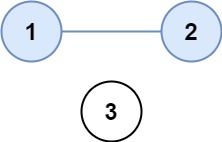
Input: isConnected = [[1,1,0],[1,1,0],[0,0,1]]
Output: 2
Example 2:
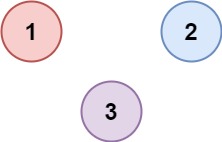
Input: isConnected = [[1,0,0],[0,1,0],[0,0,1]]
Output: 3
Constraints:
1 <= n <= 200n == isConnected.lengthn == isConnected[i].lengthisConnected[i][j]is1or0.isConnected[i][i] == 1isConnected[i][j] == isConnected[j][i]
Solution
Python3
class UnionFind:
    def __init__(self, N):
        self._parent = {}
        self._size = {}
        self.connected = N

    def union(self, a, b):
        a, b = self.find(a), self.find(b)
        if a == b:
            return
        if self._size[a] < self._size[b]:
            a, b = b, a
        self._parent[b] = a
        self._size[a] += self._size[b]
        self.connected -= 1

    def find(self, x):
        if x not in self._parent:
            self._parent[x] = x
            self._size[x] = 1
        while self._parent[x] != x:
            self._parent[x] = self._parent[self._parent[x]]
            x = self._parent[x]
        return x

class Solution:
    def findCircleNum(self, isConnected: List[List[int]]) -> int:
        N = len(isConnected)
        uf = UnionFind(N)

        for i in range(N):
            for j in range(N):
                if isConnected[i][j] == 1:
                    uf.union(i, j)

        return uf.connected