Description
You are given an undirected tree rooted at node 0, with n nodes numbered from 0 to n - 1. The tree is represented by a 2D integer array edges of length n - 1, where edges[i] = [ui, vi] indicates an edge between nodes ui and vi.
You are also given an integer array nums of length n, where nums[i] represents the value at node i, and an integer k.
You may perform inversion operations on a subset of nodes subject to the following rules:
-
Subtree Inversion Operation:
<ul data-end="890" data-start="802"> <li data-end="887" data-start="802"> <p data-end="887" data-start="804">When you invert a node, every value in the <span data-keyword="subtree-of-node">subtree</span> rooted at that node is multiplied by -1.</p> </li> </ul> </li> <li data-end="1247" data-start="891"> <p data-end="931" data-start="893"><strong data-end="931" data-start="893">Distance Constraint on Inversions:</strong></p> <ul data-end="1247" data-start="934"> <li data-end="1020" data-start="934"> <p data-end="1020" data-start="936">You may only invert a node if it is "sufficiently far" from any other inverted node.</p> </li> <li data-end="1247" data-start="1023"> <p data-end="1247" data-start="1025">Specifically, if you invert two nodes <code>a</code> and <code>b</code> such that one is an ancestor of the other (i.e., if <code>LCA(a, b) = a</code> or <code>LCA(a, b) = b</code>), then the distance (the number of edges on the unique path between them) must be at least <code>k</code>.</p> </li> </ul> </li>
Return the maximum possible sum of the tree's node values after applying inversion operations.
Example 1:
Input: edges = [[0,1],[0,2],[1,3],[1,4],[2,5],[2,6]], nums = [4,-8,-6,3,7,-2,5], k = 2
Output: 27
Explanation:
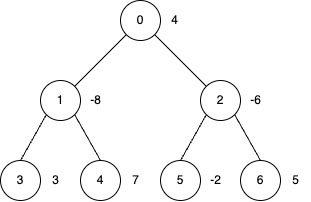
- Apply inversion operations at nodes 0, 3, 4 and 6.
- The final
numsarray is[-4, 8, 6, 3, 7, 2, 5], and the total sum is 27.
Example 2:
Input: edges = [[0,1],[1,2],[2,3],[3,4]], nums = [-1,3,-2,4,-5], k = 2
Output: 9
Explanation:

- Apply the inversion operation at node 4.
- The final
numsarray becomes[-1, 3, -2, 4, 5], and the total sum is 9.
Example 3:
Input: edges = [[0,1],[0,2]], nums = [0,-1,-2], k = 3
Output: 3
Explanation:
Apply inversion operations at nodes 1 and 2.
Constraints:
2 <= n <= 5 * 104edges.length == n - 1edges[i] = [ui, vi]0 <= ui, vi < nnums.length == n-5 * 104 <= nums[i] <= 5 * 1041 <= k <= 50- The input is generated such that
edgesrepresents a valid tree.
Solution
Python3
class Solution:
    def subtreeInversionSum(self, edges: List[List[int]], nums: List[int], k: int) -> int:
        N = len(edges) + 1
        graph = defaultdict(list)

        for u, v in edges:
            graph[u].append(v)
            graph[v].append(u)

        parent = [-1] * N

        @cache
        def dfs(node, flip, since_last):
            curr = -nums[node] if flip else nums[node]
            if_flip = -curr

            for adj in graph[node]:
                if adj != parent[node]:
                    parent[adj] = node
                    curr += dfs(adj, flip, min(since_last + 1, k))

                    if since_last == k:
                        if_flip += dfs(adj, not flip, 1)

            if since_last == k:
                return max(curr, if_flip)

            return curr

        return dfs(0, False, k)